
9/10 teams make the same mistakes
AI made everything faster, except talking to customers. Here's how to fix that without faking it.
AI is changing how teams design, build and ship products. Code, UI and creative that took weeks now take minutes. Everything is faster. Except the customer.
For those of us who want to be customer-centred in our work, this presents a problem. User research takes more than a few minutes. It can take days, even weeks, to run a study. And this is where we see people making the biggest mistakes.
Because research can take too long, or cost too much, or simply demand too much time, we progress without running any customer research at all. All too often, access to customers is rationed. Research is a bottleneck. Only a tiny fraction of the questions we have ever get answered.
So we go on assumptions and guesswork, trying to derive what the answer might be by copying competitors, or by dusting off old studies run at a different time, on a different feature.
Not good enough.
At best, AI speeds up traditional research at the margins: synthesising transcripts, or running moderation. But it can't speed up recruitment, or shorten how long it takes to involve real people in your work.
If skipping research is the old mistake, here's the newer and more dangerous one. As we worked with clients, we kept hearing the same thing: “Teams are creating their own user research using LLMs.”
Herein lies the danger. LLM roleplay gives the appearance of user research, but it isn't. The model is guessing from stereotypes it absorbed in training, not from anything it knows about your actual customers. And if everyone fabricates their own version of the customer, you no longer share a single view of who that customer is.
It reminds us of a product team who, asked whether they tested with customers, said: “Yes, each Wednesday one of us pretends to be the customer.” What could possibly go wrong?
If pretending to be your own customers doesn't work, then using LLMs to fabricate them isn't the answer either. But it does make one thing clear: exactly what a real solution would have to do.
User research as fast as an LLM, with access for everyone. No bottlenecks. No wait times. No costly fees. Instant customer feedback.
The challenge is how to make that a robust research workspace.
Synthetic humans
If you have data and insight on your customers, you already have the foundations of synthetic humans.


What is a synthetic human? It bundles your data into a model of your customer, one that thinks, acts and decides just like the real thing. Once generated, it answers your questions in seconds. LLMs can't do that.
To fix those mistakes and unlock the potential of AI, you need to build synthetic humans that are true to your customers. Each model needs four parts.
LLMs don't model how people actually think. A true synthetic platform simulates perception, memory formation, attention and goal-setting using computational frameworks that mirror human mental processes. This creates agents that reason like real users, with both deliberate analysis and fast, intuitive judgment.
People don't optimise perfectly. They satisfice, lean on heuristics and make irrational choices under pressure. A decision model captures both rational evaluation and the cognitive constraints behind suboptimal choices, so synthetics predict the messy, real-world decisions humans actually make.
Authentic behaviour emerges from context, history and cross-scenario consistency. Unlike an LLM giving an isolated response, a behavioural model maintains causal chains across situations. It remembers past interactions, holds preferences over time and shows the long-horizon patterns of real product use.
Every complex behaviour decomposes into building blocks: psychological constructs, elemental responses, atomic actions. We work back from your insights to ground synthetics in their primitives, preserving the individual differences, edge cases and long-tail behaviours that get lost when LLMs average toward a generic, agreeable persona.
Go deeper on the modelling approach in the science behind Sunzu.
The solution
With a model, you can bring your customers to life as synthetic humans. Ask them anything and get answers in seconds, at a fraction of the cost of traditional research.
That's what we set out to build at Sunzu.ai: a lightning-fast user research platform that's available to everyone. Sunzu isn't generic LLM roleplay. It models your customers, with governance and traceability, and is back-tested against your data.
Run studies directly from Microsoft Teams, Claude or any other productivity stack, or from your own dedicated instance of Sunzu.ai.
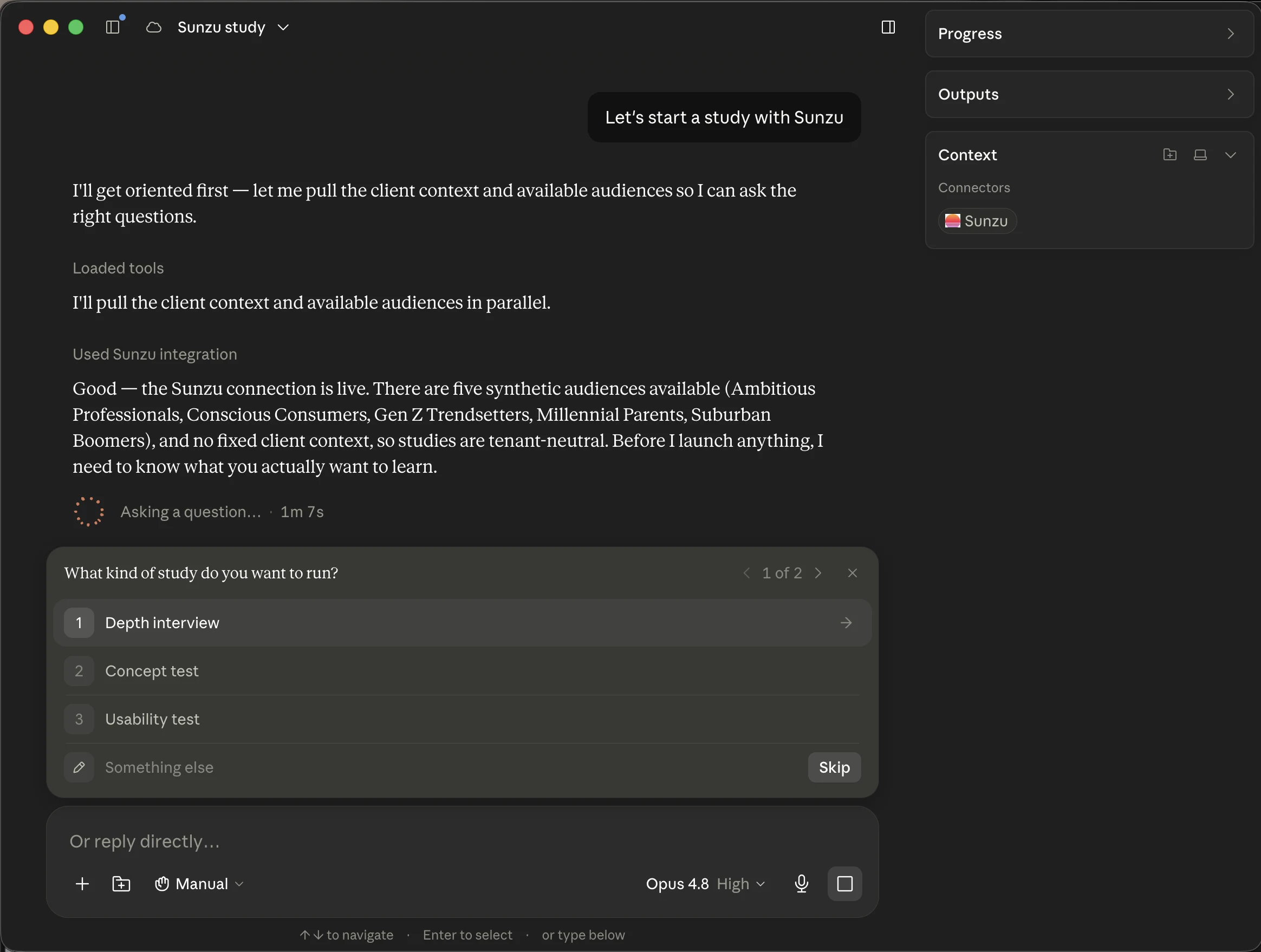
Synthetic humans run your whole research stack
- Discovery interviews
- Focus groups
- Concept tests
- Feature tests
- Usability tests
- Ad testing
Explore each one on the use cases page.
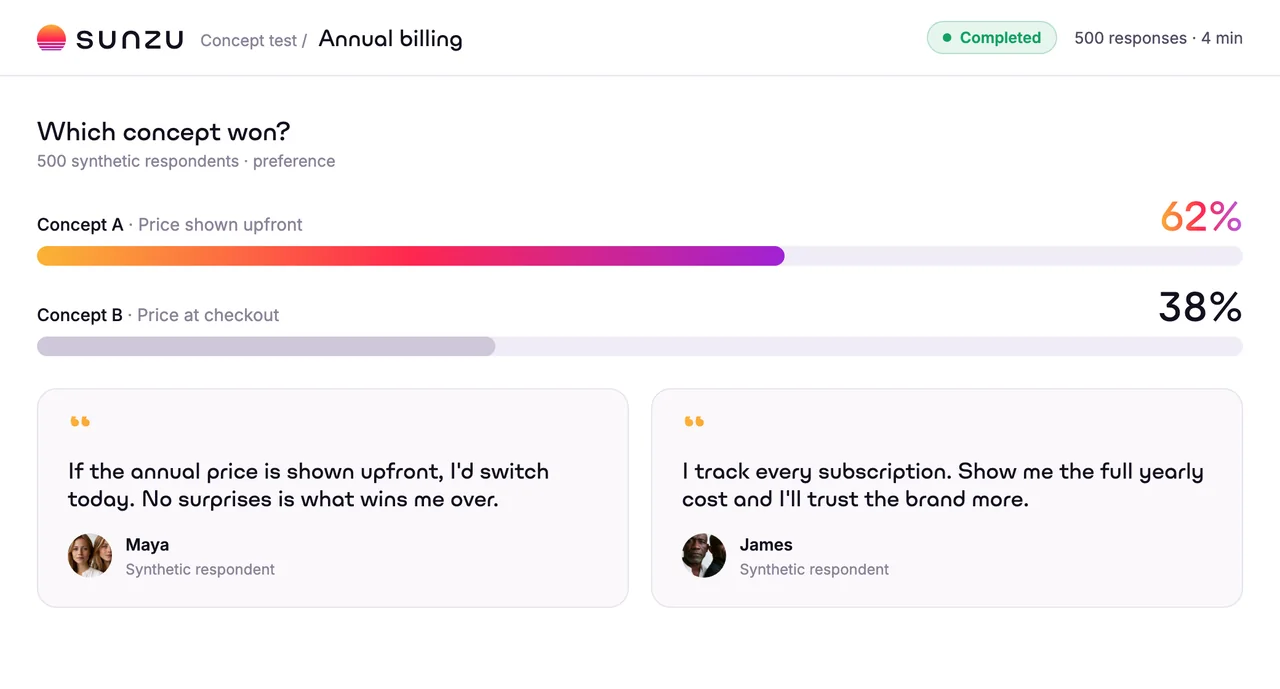
Picture it: ask 500 of your customers whether they'd switch to annual billing, then read the answers before your coffee gets cold.
And you can still run human studies. In fact, we'd encourage it. There's nothing quite like hearing customers describe their problems, or their experience of your product. Those memories stay with you. But they're only part of the research picture. With synthetic humans, everyone can involve the customer in their work, at any time. The bottleneck is lifted.
Run a study in minutes, not weeks.
Can I trust the data?
When we launch an instance of Sunzu for you, we run cycles of back-testing, pitting our synthetics against your data and remodelling your audience until they react, behave and think the way your customers do.
How we keep results defensible → Trust.
Want this measured on your own data? Book a call →
Synthetic or real customers?
Want a rule of thumb for synthetics versus real people? For inclusive design, where users may have disabilities or there are cultural or ethical sensitivities, speak directly to end users. In almost any other case, synthetic humans are a viable option. For the full decision framework, see the FAQ.
How do I get started?
Book a call or see it live, and we'll set you up with a trial of Sunzu. Play with our standardised audiences and experience the platform first-hand. Ready to go further? We'll model your customers and create your own custom synthetic humans.
AI is changing the game, unlocking new ways to embed the customer in your product, marketing and design process. Don't fall into the trap of fabricating customers with LLMs and prompts. That's a road to nowhere. To unlock the opportunity and truly transform your user research, you need synthetic humans modelled on your real customers.
It's time to meet your
synthetic humans.
Next in the series → Engineered, not prompted: how we build synthetic humans (Nº 02).
Your customers, on call. Day or night.
Book a call and we'll set you up with a trial of Sunzu. Play with our standardised audiences first-hand, then let us model your own customers into custom synthetic humans.